
Dentists generally suggest a child’s first visit by around their first birthday, or within six months of the first tooth appearing. It sounds early, but the aim of that visit is less about treatment and more about starting on the right foot — for the child and for you.
Early visits let a dentist watch how the teeth and jaw are developing, spot habits worth adjusting, and give you tailored advice on brushing, diet and thumb-sucking. Just as importantly, a child who meets the dentist while nothing hurts learns that the chair is a friendly place, not somewhere you go only when something is wrong.
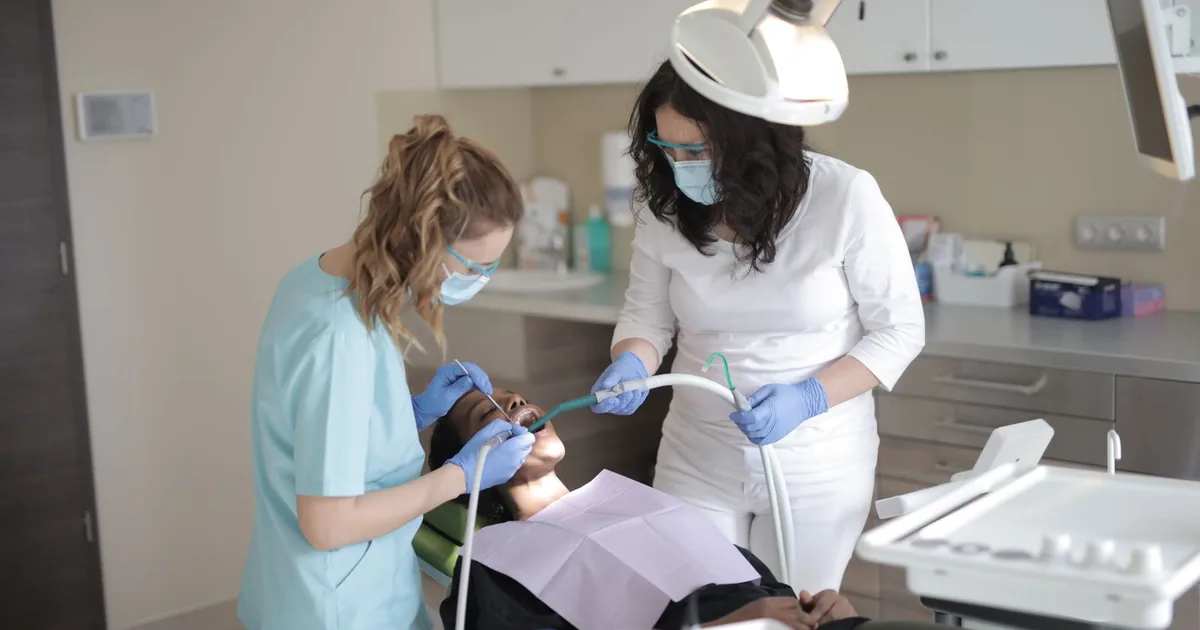
A first appointment is typically gentle and short: a look at the teeth and gums, perhaps a soft clean, and a chat about care at home. If your child is wary, a good clinic will go at their pace and let them sit with you. The visit is as much about building trust as anything clinical.
Regular, uneventful visits are what keep dental care ordinary rather than frightening. Helping your child brush twice a day, going easy on sugary drinks, and keeping up routine check-ups sets a foundation that tends to last well into adulthood.
Most children in India do not see a dentist at one, and a good number arrive for the first time at four, five or later, usually because something has started to hurt. If that is your situation, the useful thing to know is that nobody is going to make you feel bad about it, and the visit is worth booking now rather than after the next school holiday.
A two-year-old can absolutely come. So can a three-year-old, and a four-year-old. What changes with age is not whether the visit is possible but how it goes: a toddler is usually examined on your lap in a few minutes, while a five-year-old can generally sit in the chair and follow instructions. Neither is difficult.
The reason for going early is not that a one-year-old needs treatment. It is that decay in small children moves quickly, and a problem caught as a white mark on the enamel is a conversation about diet and brushing, while the same problem eighteen months later can be a filling or a crown under sedation. The visit is cheap insurance against the difficult version.
Every six months is the standard interval, and it applies just as much to a seven-year-old as to anyone else. It is frequent enough to catch decay while it is small, and frequent enough that the child never quite loses familiarity with the place.
Some children are asked to come more often — every three or four months — and that is not a bad sign so much as a practical one. Children who have already had decay, who wear braces, who have deep grooves in their back teeth, or who have a medical condition affecting saliva or diet are at higher risk, and the shorter interval exists to catch things early.
There is no age at which a child stops being welcome. Practically, children move to ordinary adult appointments somewhere in the mid-teens, once the last milk teeth have gone and the adult set is established.
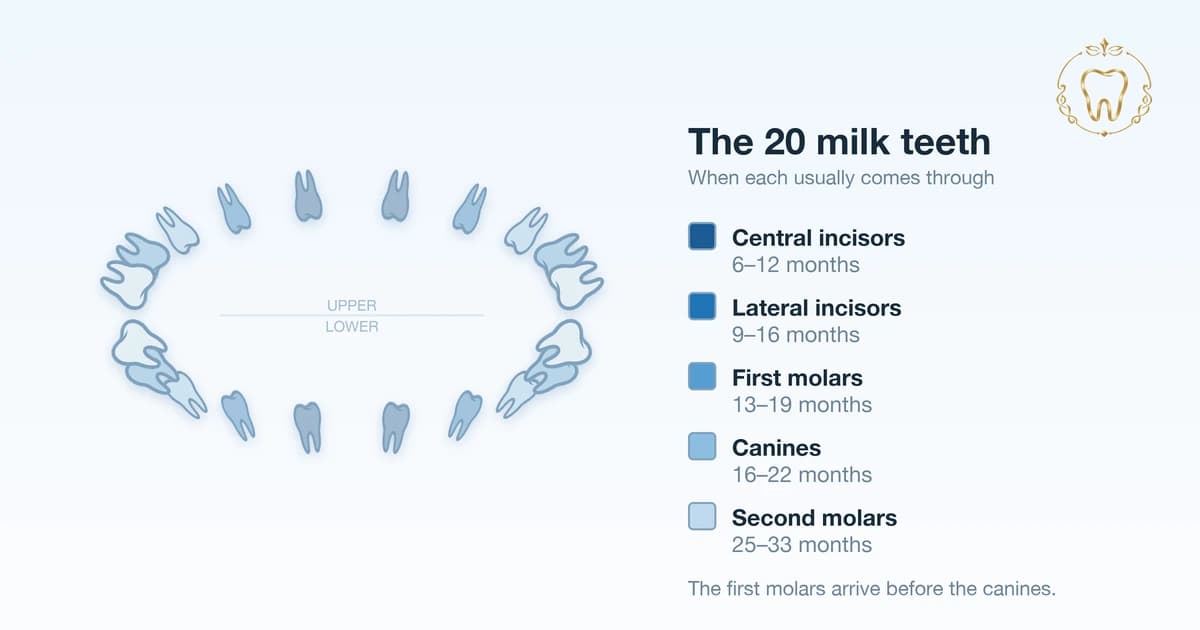
A child has twenty milk teeth, not the thirty-two an adult has. There are no premolars and no wisdom teeth in the baby set. The full twenty are usually in place by around three years old — our guide to teething covers the order they arrive in and roughly when.
The change begins at about six. What confuses many parents is what comes first: the first adult molars erupt right at the back, behind the existing milk teeth, without anything falling out to make room. They are permanent teeth, they arrive silently, and they are frequently mistaken for baby teeth and treated as disposable. They are not. They are the teeth most likely to decay in the whole mouth, because they arrive when a six-year-old is still brushing badly and sit right at the back where the brush reaches last.
The front teeth loosen from around six or seven, and the last milk teeth are usually gone by eleven or twelve.
A tooth lost at four is early. It usually means one of two things — a fall, or decay that has gone further than anyone realised — and both are worth looking at rather than waiting for the adult tooth. A milk tooth lost years before its time leaves a gap that the neighbouring teeth drift into, and the adult tooth underneath then has nowhere to come up. That is one of the commonest routes to crowding, and it is preventable with a space maintainer if it is caught.
Three things are worth acting on rather than watching.
Gums that bleed when brushed. Bleeding is not a normal part of brushing at any age. In a child it usually means plaque sitting along the gumline, and it usually resolves with better brushing rather than treatment — but it should resolve.
Breath that stays bad. Morning breath is ordinary. Breath that is persistently unpleasant through the day can mean decay, food packing between teeth, or an infected tooth.
White chalky patches or brown marks near the gumline, particularly on the upper front teeth. These are early decay, and at the white-patch stage they can sometimes be arrested rather than filled. This is the single most useful thing a parent can spot, because it is visible before it hurts.
Also worth a look: a child chewing only on one side, complaining a tooth feels tall, or refusing cold food they used to eat.
Cavities in a seven-year-old are common. Common is not the same as unimportant — it means the pattern is familiar and treatable, not that it can be left.
Yes. A child’s appointment is charged like any other, and a first visit for a small child is usually short and straightforward. What is worth asking when you book is what the visit includes, and whether anything likely to be needed — an X-ray, a cleaning, fluoride application — is charged separately, so the figure you are told at the desk is the figure you expected.
If cost is the reason a visit keeps being postponed, it is worth weighing against what it is being postponed towards. A check-up is the least expensive appointment in dentistry; a decayed molar needing a pulpectomy and a crown is one of the more expensive ones for a child, and the gap between the two is often eighteen months of nothing being done.
The short version: you do it, for longer than you think. Most children do not have the fine motor control to brush properly until around eight, however capable they seem, and a child who brushes enthusiastically is not the same as a child who brushes effectively.
The detail — how much toothpaste at which age, why sugar frequency matters more than quantity, and what actually causes decay in small children — sits on our children’s dentistry page, along with the conditions we see most often and how each is treated.
One thing that deserves saying directly, because parents ask it in exactly these words: not brushing a small child’s teeth is not neglect, it is common, and it is usually a matter of a hard bedtime rather than indifference. What matters is what happens from here. Two minutes, twice a day, done by you, changes the trajectory more than anything else on this page.
Early, friendly visits are the simplest way to keep dental care stress-free for your child. None of this replaces an in-person check-up — every mouth is different, and a quick look often settles what guesswork cannot. If something has been bothering you for more than a few days, it is worth getting it seen early, while it is still simple to treat.
At Kosmoss Dental in Indirapuram, we are happy to talk through what you are noticing and explain the options before anything is decided. Give us a call or drop by the clinic to book a time that suits you.
Author