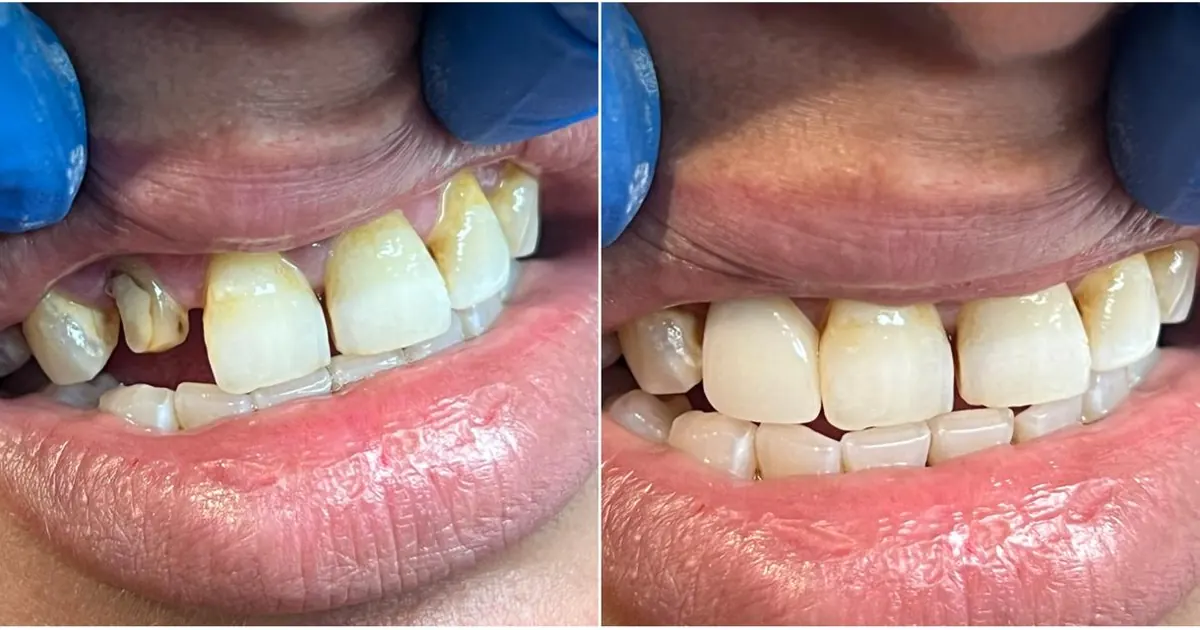
If a dentist has told you that a tooth needs a “cap”, they are talking about a dental crown. The two words describe exactly the same thing — a custom-made cover that sits over what is left of a damaged tooth and takes over its shape, strength and biting surface. “Cap” is the everyday word; “crown” is what you will see written on your treatment plan and your bill.
Being told you need one usually raises the same handful of questions: why can a filling not do the job, what are the different materials for, how much should this cost, and how long will it last. This is a plain account of all of that, along with what to do when a crown starts trapping food or comes loose — the two things that send most crown patients back to a clinic.
A root canal removes the infected pulp from inside a tooth and seals the space. The infection is dealt with, and the pain goes. What the treatment cannot do is give the tooth back its strength.
To reach the pulp, the dentist has to drill through the top of the tooth. Combined with whatever decay or fracture made the treatment necessary in the first place, a good deal of the original tooth structure is gone by the end. A root-treated tooth also no longer has a living blood supply, so it becomes more brittle over time.
Back teeth take the heaviest load during chewing. A large filling in a hollowed-out molar has nothing solid to hold on to, and the tooth tends to split — often below the gumline, at which point it usually cannot be saved. A crown wraps the whole tooth instead of filling a hole in it, which is why it is routinely advised on molars and premolars after a root canal.
Front teeth are a different case. They take far less chewing force, and if the tooth is largely intact a filling may be enough. This is worth asking about directly rather than assuming: does this particular tooth need a crown, or would a filling hold? A dentist should be able to show you on the X-ray how much tooth is actually left.
Root canals are the most common route to a crown, but not the only one:
A cracked or fractured tooth. A crown holds the pieces together and stops the crack spreading. Timing matters here — once a crack reaches the root, the tooth is usually lost.
A tooth worn down by grinding. Long-term clenching or grinding can flatten teeth considerably. Crowns restore the height, though the grinding itself needs addressing too, or the new crowns wear as well.
A very large old filling that keeps failing. When a filling covers more of the tooth than the tooth does, it flexes each time you bite and eventually leaks or breaks.
As part of a bridge. To replace a missing tooth with a bridge, the teeth on either side are crowned and the replacement tooth is joined between them.
On top of an implant. An implant replaces the root; a crown is what is fitted on top of it to do the visible work.
Cosmetic reasons, occasionally — a badly discoloured or misshapen front tooth. Veneers are often the more conservative option here, because a crown means reshaping the whole tooth rather than just its front surface.
Most crowns are done across two appointments, usually a week or two apart.
First appointment. The tooth is numbed, then reduced in size by roughly one to two millimetres on all surfaces so the crown has room to sit without making the bite too tall. If the tooth is broken down, a build-up may be placed first to give the crown something to grip. An impression or a digital scan is taken, the shade is matched against your other teeth, and a temporary crown in acrylic is cemented on to protect the tooth while the permanent one is made.
Between appointments. The temporary is deliberately weakly cemented so it can be removed easily later. Chewing very sticky or hard food on that side can pull it off. If it does come off, keep it and call the clinic — the prepared tooth underneath is often sensitive and should not be left uncovered for long.
Second appointment. The temporary comes off, the permanent crown is tried in, and the fit, shade and bite are checked before anything is fixed permanently. This is the moment to speak up. Once it is cemented, adjusting a crown means grinding it down or cutting it off. If it feels tall, catches when you slide your teeth sideways, or the colour looks wrong to you in daylight, say so before it is cemented.
Some clinics offer same-day crowns milled on site. These are convenient and can be a good option, though the material choice is narrower than with a laboratory-made crown.
The tooth is numbed for the fitting, and that numbness usually takes two to four hours to wear off. Do not chew anything until it has. It is easy to bite the inside of a numb cheek or lip hard enough to leave a painful ulcer for the rest of the week, and children and older patients do this most often. Sipping water is fine straight away.
Once the numbness has gone, a permanent crown is ready to use. The cement holds it from the moment it sets in the chair. It is still sensible to keep the first day gentle — eat on the other side, and leave anything very hard or very sticky until the following day. Toffee, chikki, hard chocolate and ice are the usual culprits.
A temporary crown is a different matter and needs real care for the whole one to two weeks it is in place. It is cemented weakly on purpose so it can be lifted off easily at the next visit. Chew on the other side, avoid sticky food altogether, and when you floss beside it, pull the floss out sideways rather than up, or you will lift the temporary straight off.
Some sensitivity to cold in the first days is normal, particularly on a tooth that still has a live nerve, and it usually settles over a few weeks. Gum around the crown can feel tender or look slightly inflamed for a couple of days after the fitting, because the margin sits close to it. Neither of these means something has gone wrong.
What is not normal, and is worth a phone call rather than a wait: the crown feeling tall or hitting first when you close, sharp pain when you bite down, a throbbing ache that builds over days, or any swelling of the gum or face. A bite that is even slightly high will not settle on its own — it overloads the tooth and causes exactly the ache people assume they should tolerate. It takes a few minutes to adjust.
There is no recovery period in the sense of a wound healing. Nothing was cut and there are no stitches. Most people are back to eating normally within a day or two, and the tooth simply stops being something you notice.
Material is usually the biggest decision, and the difference is mostly a trade-off between strength, appearance and how much tooth must be removed.
Metal crowns (nickel-chromium or cobalt-chromium alloys) are the strongest and longest-lasting, and need the least tooth removed. They are entirely metallic in appearance, so they are generally used only on back molars where they do not show. For a second molar under heavy load, a metal crown is often the most durable choice available.
PFM — porcelain fused to metal. A metal shell with tooth-coloured porcelain baked over it. This was the standard for decades and remains widely used. It is strong and looks reasonable, but the metal underneath can show as a dark line at the gum edge over the years, particularly if the gum recedes slightly. More tooth has to be removed than for a plain metal crown, because the crown needs room for both layers.
Zirconia. A very strong ceramic with no metal at all, so no dark line ever appears. Modern layered zirconia is a reasonable match for natural teeth and is strong enough for molars. It has become the common choice where both strength and appearance matter.
E-max (lithium disilicate). A glass ceramic with the most natural translucency of the options here, which is why it is favoured for front teeth. It is strong, though generally not the first choice for a heavily loaded back molar.
A reasonable rule of thumb: appearance matters most at the front, load matters most at the back, and the right answer for a second molar is often not the right answer for an upper incisor. If a single material is being recommended for every tooth in your mouth, it is fair to ask why.
These are our own charges at the clinic in Niti Khand I, per tooth, as of 2026:
Metal crown: ₹3,500 – ₹4,000 per tooth
PFM crown: ₹5,000 – ₹7,000 per tooth
Zirconia or E-max crown: ₹10,000 – ₹15,000 per tooth
Two things are worth understanding about these figures. First, if the crown follows a root canal, the root canal is a separate cost — and if the tooth needs a post and core build-up before crowning, that is another line again. Ask for the total for the whole sequence rather than the crown alone, otherwise the final bill comes as a surprise.
Second, a wide gap in quoted prices for the same named material usually comes down to the laboratory. “Zirconia” covers a broad range of products, and a crown milled from a well-known block by an experienced technician is not the same object as the cheapest available version, even though both are accurately described as zirconia. It is a fair question to ask which laboratory and which material brand a quote is based on.
Be cautious about a price quoted without an examination. Until someone has looked at the tooth and an X-ray, nobody knows whether a build-up is needed, whether the gum needs treating first, or whether the tooth is restorable at all.
A well-made crown on a well-maintained tooth commonly lasts ten to fifteen years, and often considerably longer. Metal crowns tend to outlast the others. But the crown itself is rarely what fails.
What fails is the tooth underneath. Decay can start at the margin where the crown meets the tooth, especially if that edge sits below the gumline and is hard to clean. Gum disease can undermine the support. And because a root-treated tooth has no nerve, decay under a crown can advance a long way without any pain at all — which is precisely why a crowned tooth still needs checking.
The habits that shorten a crown's life are unglamorous and familiar: chewing ice, opening things with your teeth, cracking hard nuts and shells, and untreated night grinding. If you grind, a night guard protects the crown far more cheaply than replacing it does.
There is no fixed number of times a tooth can be crowned. The limit is not the crown, it is how much sound tooth is left underneath. Each replacement means removing the old crown and cleaning up whatever decay has crept in beneath it, and a little more tooth goes each time. A tooth crowned in its thirties may be crowned again in its fifties without difficulty. By the third or fourth time there is often not enough structure left to hold anything, and the choice becomes a post and core, or removing the tooth and replacing it.
Leaving a failing crown in place is what actually costs people the tooth. A crown that has lost its seal lets bacteria sit against the tooth surface, and on a root-treated tooth there is no nerve to signal what is happening. The decay works down towards the root quietly. What began as a crown that needed re-cementing becomes a tooth that has decayed below the gumline and cannot be restored. The gap between those two situations is usually months, not years, and the difference in cost between them is considerable.
Food packing into the same spot after every meal is one of the most common complaints about a crowned tooth, and it is worth taking seriously rather than living with.
It usually means the contact point between the crown and its neighbour is not tight enough. A natural tooth touches its neighbour along a firm, slightly broad contact. If a crown's contact is loose or shaped wrongly, food is forced into the gap each time you bite and stays there.
This is not merely irritating. Food held against the gum overnight causes inflammation, and over months it can produce a genuine pocket, bone loss between the teeth and decay on the neighbouring root surface. Persistent bad breath from one specific spot is often this.
Clean the area properly in the meantime — floss taken gently down and curved around the tooth, or an interdental brush of the right size, which is usually easier to use and more effective in a space that is already open. What you should not do is dig at it with anything rigid and pointed: pins, needles and toothpicks damage the gum and can chip the crown margin.
Then get it looked at. If the crown is recent, the contact can sometimes be corrected. If not, it is still better to know how much of a gap there is than to manage it with floss indefinitely.
A crown that moves when you press it, or that lifts slightly when you chew something sticky, has usually lost part of its cement seal. Once saliva and bacteria get under a crown, decay follows quickly, and it does so silently on a root-treated tooth.
If the crown comes off completely, keep it. In most cases it can be re-cemented, and the intact crown is far more useful to your dentist than a description of it. Rinse it, keep it somewhere safe, and bring it with you.
A few things not to do. Do not try to glue it back with any household adhesive — superglue and similar products are not safe in the mouth, they are difficult to remove, and they frequently make a crown that could have been re-cemented unusable. Do not force it back on hard, since if it seats at a wrong angle it can be very difficult to get off again. And do not simply leave the tooth uncovered for weeks: the prepared tooth underneath is small, often sensitive, and the neighbouring teeth will start drifting into the space within a surprisingly short time, after which the original crown may no longer fit.
A loose crown is not usually an emergency in the sense of severe pain, but it is genuinely time-sensitive. Getting it seen within a few days rather than a few months is often the difference between re-cementing the existing crown and paying for a new one.
A crown does not decay. The margin where it meets your tooth does, and that margin is the whole game.
Brush normally, twice a day, with attention to the gumline rather than the crown itself — a soft brush angled towards the gum, not scrubbed hard across it. Harder brushing does not clean the margin better; it wears the gum back and exposes more root surface, which is more vulnerable to decay than enamel.
Clean between the teeth daily. Floss or an interdental brush, whichever you will actually use consistently.
A bridge needs one extra step, and it is the step people miss. A bridge is joined, so ordinary floss cannot pass down between its units. The replacement tooth sits directly on the gum, and plaque collects underneath it. Cleaning under a bridge needs a floss threader or superfloss, which carries floss under the joined section, or a small interdental brush passed beneath it. Without this, the gum under a bridge becomes inflamed and the supporting teeth — which are carrying the whole structure — are put at risk.
Book an appointment rather than waiting if you notice any of the following:
The crown moves at all when you press on it. Food packs into the same spot after every meal. The gum around the crown bleeds when brushed, or is tender and puffy on one side only. A dark line appears at the gum edge and the gum looks like it is shrinking back. The tooth becomes sensitive again, or aches when you bite on it. There is a persistent bad taste or smell from one particular tooth. Or the crown chips, or feels rough against your tongue.
Pain is worth singling out. A root-treated tooth with a crown has no nerve to complain, so pain on biting can indicate a problem at the root tip or a fracture in the underlying tooth, and neither improves on its own. Swelling in the gum or face alongside it should be seen promptly.
Even with nothing wrong, a crowned tooth benefits from a routine check and a professional clean at the usual six-monthly interval. The point is to catch decay starting at a margin while it is still a small repair, particularly on teeth that can no longer warn you with pain.
If you have been told several teeth need crowning and the plan feels larger than you expected, asking another dentist to look is entirely reasonable and no dentist should take offence at it. Bring your X-rays if you can. Crowning a tooth is not reversible — healthy tooth structure is removed to make room, and it does not grow back — so it is worth being clear about why each individual tooth needs one.
Equally, a crown that has been genuinely recommended is usually best not postponed. Most of the situations that lead to a lost tooth begin as something small and painless that was left for another year.
Is capping a tooth painful? The tooth is numbed before it is prepared, so the appointment itself should not hurt. Most people describe the pressure and the sound of the drill as the unpleasant parts rather than pain. Afterwards, mild soreness and cold sensitivity for a few days are common and settle on their own.
Do you get anaesthesia for a crown? Yes, local anaesthetic for the preparation appointment. The second appointment, where the finished crown is cemented, often needs none at all, because the tooth is only being cleaned and the crown seated.
Can I eat normally with a crown? Yes, once the permanent crown is cemented and the numbness has worn off. A well-fitted crown handles ordinary chewing exactly as the tooth did. The habits worth dropping are the ones that damage natural teeth too: chewing ice, cracking shells and nuts, and opening packets with your teeth.
Can I bite an apple with a crown? Yes, once it is permanent. Biting into hard fruit with a crown on a front tooth applies a sideways force rather than a straight one, so if you have several front crowns it is kinder to cut the apple into pieces. With a temporary crown, do not bite into anything hard at all.
Can I eat pizza with a permanent crown? Yes. A crust is not a problem for a cemented permanent crown. With a temporary in place, tear the crust rather than pulling at it, since that dragging motion is what lifts temporaries off.
How long after a crown is cemented can I drink water? Straight away. Water does not affect the cement. The only reason to wait is the numbness — it is easy to spill or dribble without feeling it.
How long does it take to recover from a dental crown? There is nothing to heal, so most people feel normal within a day or two. Cold sensitivity can linger for two to three weeks on a tooth with a live nerve.
How many times can you cap a tooth? As many times as there is enough healthy tooth left to hold a crown. Practically that is often two or three, because each replacement removes a little more structure.
Is capping a tooth safe? Yes, it is a routine and long-established treatment. The one thing to be clear about is that it is not reversible: healthy tooth has to be reduced to make room, and it does not grow back. That is why it is worth asking whether a filling or an onlay would hold before agreeing to a crown.
Why do dentists recommend crowns so often? Usually because the tooth genuinely cannot hold a filling any longer — after a root canal, or once a filling covers more of the tooth than the tooth does. It is a fair question to ask directly, and a reasonable dentist will show you on the X-ray how much tooth is left and explain what happens if you wait. If several teeth are being crowned at once and the reasoning is not clear to you, a second opinion is sensible.
Is there a substitute for a crown? Sometimes. An onlay covers only the damaged part of the biting surface and keeps more of the natural tooth, and it can be the better option when the walls of the tooth are still sound. A large filling can hold on a front tooth that takes little chewing force. On a root-treated molar there is usually no real alternative.
How often do crowns fail? Most crowns last well beyond ten years, and the crown itself rarely breaks. What fails is the tooth beneath it — decay starting at the margin, or gum disease loosening the support. That is why a crowned tooth still needs a check-up and a clean, especially one that can no longer warn you with pain.
When is it too late to put a crown on a tooth? When there is not enough sound tooth left above the gum to hold one, or when a crack has run into the root. At that stage the options are a post and core if the root is healthy, or removing the tooth. This is the reason a cracked tooth is worth seeing quickly rather than watching.
Kosmoss Dental is in Niti Khand I, Indirapuram, and Dr Varnica Sharrma sees crown, bridge and post-root-canal cases here. If you have been told you need a cap, have a crown that has come loose, or are trying to decide between materials, bring any X-rays you already have and we can go through the options and the costs for your particular tooth before you commit to anything.
You can call or WhatsApp +91 98999 86789, or book an appointment here. Walk-ins are welcome, and a loose or lost crown is worth getting seen sooner rather than later.
Author
No tags available