Few things unsettle new parents like a baby who has been cheerful for months and suddenly will not settle. Teething gets blamed for a great deal — some of it fairly, and some of it not at all. Knowing which is which matters, because the symptoms teething does not cause are usually the ones that need a doctor.
This is a plain account of when teeth arrive and in what order, what teething genuinely does, what it does not, what actually helps, and the handful of remedies that are still sold in India and should not be used.
Most babies get their first tooth somewhere between six and ten months, though anywhere from three months to a year is still ordinary. The order is more consistent than the timing.
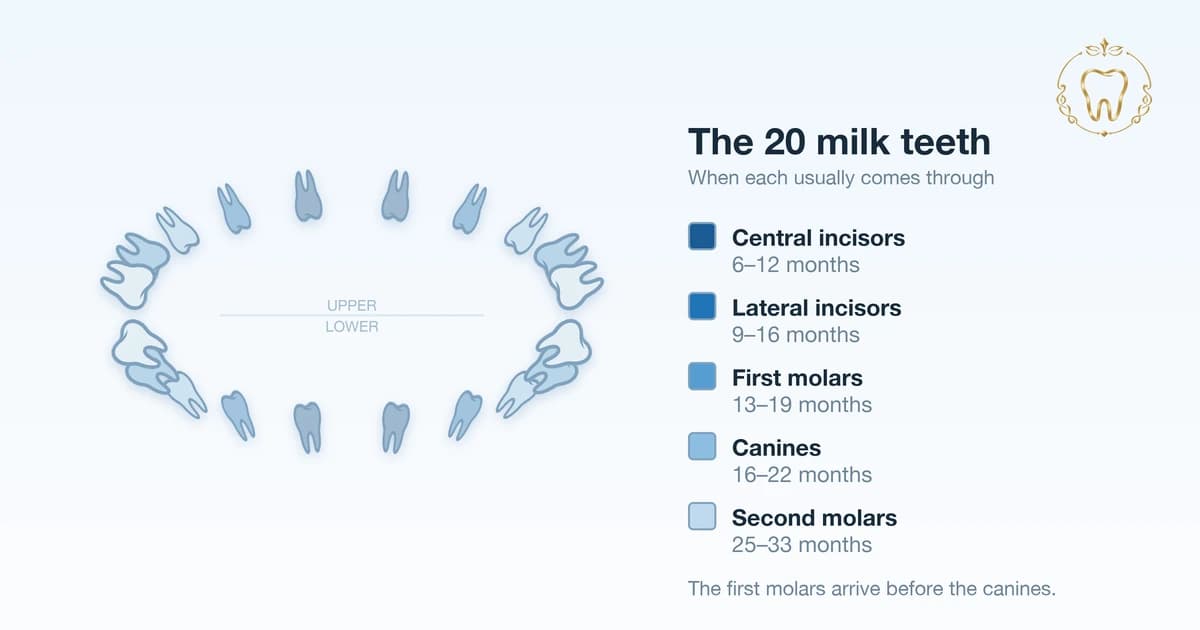
The two lower front teeth (central incisors) usually come first, around six to ten months. The two upper front teeth follow at eight to twelve months, then the upper side teeth (lateral incisors) at nine to thirteen months and the lower ones at ten to sixteen months.
The first molars — the broad chewing teeth further back — arrive around thirteen to nineteen months. The canines, the pointed teeth beside the front four, come at sixteen to twenty-two months. The second molars come last, roughly twenty-five to thirty-three months.
By around three years old a child has a full set of twenty milk teeth. Adults have thirty-two, but children have twenty — there are no premolars and no wisdom teeth in the baby set.
If you are wondering which stage is hardest: most parents report the first tooth and the first molars as the two uncomfortable ones. The first tooth because nothing has broken through that gum before, and the first molars because they are wide and blunt rather than sharp-edged.
The genuine signs are local to the mouth and mild. A tooth pushing through the gum causes soreness in that spot, and the rest follows from it.
Expect more drooling than usual, and often a mild rash on the chin or chest simply from the wet. Expect chewing — on fingers, on toys, on the edge of a cot, on you. Expect a red, slightly swollen patch of gum where the tooth is coming, sometimes with a small bluish swelling over it, which is a harmless blood blister and settles on its own.
Expect a baby who is more irritable than usual, sleeps worse, and eats a little less. Some babies rub the cheek or pull at the ear on the side where a tooth is coming, because the discomfort refers along the jaw.
A slightly raised temperature can happen — a few tenths of a degree. That is the limit of it.
This section matters more than any other on this page.
Teething does not cause a real fever. Large studies that followed babies daily through tooth eruption found only a very small rise in temperature, well below the threshold for fever. A temperature of 38°C or above is an illness, not a tooth, and it needs a doctor — particularly in a baby under three months.
Teething does not cause diarrhoea. The idea that a teething baby produces looser stools is widespread and it is not supported. Persistent loose stools in an infant mean dehydration risk and deserve medical attention rather than being waited out.
Teething does not cause a cough, a runny nose or congestion. It does not cause vomiting, a widespread body rash, or a baby who is floppy, unusually drowsy or refusing all feeds.
The reason this confusion is so persistent is a coincidence of timing. Babies are born with antibodies passed from their mother, and that protection fades from around six months — which is precisely when teeth start arriving. So a baby of that age gets more infections than before, and the teeth get the blame for the illnesses.
The practical rule is simple. Mild, local, mouth-centred and short-lived is teething. Systemic, severe or persistent is something else, and something else is what a doctor should look at. It is worth being blunt about this: children have been unwell for days while a genuine infection was put down to a tooth.
Ear infections come high on the list, because both cause ear-pulling and disturbed sleep at the same age. An ear infection usually brings fever and more inconsolable distress, and it needs treating.
Ordinary viral illnesses account for most of it — runny nose, cough, mild fever, loose stools. Hand, foot and mouth disease causes genuine mouth ulcers and refusal to feed, along with spots on the hands and feet. Oral thrush shows as white patches inside the cheeks that do not wipe away easily.
And occasionally a baby is simply going through a sleep regression or a growth spurt, and no tooth appears for weeks afterwards.
Pressure and cold are the two things that reliably work, and both are simple.
Counter-pressure on the gum helps most. A clean finger rubbed firmly over the sore spot for a minute often settles a baby immediately. A clean, damp piece of gauze wrapped round your finger does the same and adds a little texture.
Something firm and cold to chew is the other. A solid silicone teething ring, chilled in the fridge — not the freezer — is ideal. Frozen solid, a teether becomes hard enough to bruise the gum. A clean flannel dampened and cooled in the fridge works just as well and costs nothing.
For a baby already on solids, chilled soft food does double duty: cold yoghurt, or cold pureed fruit. For babies over about six months who can hold things safely and are supervised throughout, a cold cucumber stick or a chilled carrot to gnaw on works, though anything that can break off into a piece needs watching closely.
Wipe the drool from the chin through the day with a soft cloth and, if the skin is getting sore, a plain barrier cream helps.
Distraction is underrated. A baby absorbed in something is a baby not noticing a gum.
If your child is genuinely distressed and none of this is enough, infant paracetamol at the correct dose for weight and age is reasonable. Check the dose with your paediatrician rather than estimating, and do not use it night after night without asking why it is needed.
Several teething remedies are still sold in India that are not worth the risk.
Teething gels containing choline salicylate. Salicylates are in the aspirin family, and aspirin is avoided in young children because of its association with Reye’s syndrome, a rare but serious condition affecting the liver and brain. Check the ingredients before buying any gel.
Benzocaine gels. Benzocaine is a local anaesthetic linked to methaemoglobinaemia in infants — a condition where the blood carries oxygen poorly. Regulators including the US FDA have warned against its use for teething in children under two.
Amber teething necklaces. There is no mechanism by which these could work, and they carry two genuine risks: strangulation if worn during sleep, and choking if a bead comes loose. No baby should wear anything round the neck unsupervised.
Anything frozen solid. Chilled is the aim, not frozen. Ice and rock-hard teethers bruise gums.
Alcohol rubbed on the gums. Brandy or whisky on a baby’s gums is old advice that still circulates. Alcohol is toxic to infants in small amounts. Do not.
Honey on the gums. Honey should not be given to any child under one year because of the risk of infant botulism, and rubbing it on gums is no exception.
Late teething worries parents far more often than it turns out to be a problem.
The great majority of late teethers are simply following a family pattern — ask the grandparents when you and your partner got your first teeth, and the answer is often the explanation. Babies born prematurely also tend to run late, and their teeth are better judged from their due date than their birth date.
Occasionally there is a medical reason. Severe vitamin D deficiency, which affects bone development, can delay eruption — and it is worth knowing that vitamin D deficiency is common in India despite the sunshine, largely because of indoor living and covered clothing. An underactive thyroid can delay it. Some rarer inherited conditions affect how teeth form. None of these is common, and none is diagnosed from the teeth alone.
As a rough guide: no teeth at all by twelve months is worth mentioning at a routine check, and no teeth by eighteen months is worth an examination. What a dentist will do is look, and usually take an X-ray to confirm the teeth are there under the gum and simply late — which is what it almost always turns out to be. Confirming that is worth the visit on its own.
The opposite happens too, though rarely. A few babies are born with a tooth already through, or get one in the first month. These are usually loose and are checked to see whether they are safe to leave or need removing, because a very mobile one carries an inhalation risk and can make feeding painful.
The care starts before the first tooth arrives. Wiping a baby’s gums with a clean damp cloth after feeds gets both of you used to the routine.
Once the first tooth is through, brush it. Twice a day, with a soft baby brush, using a smear of fluoride toothpaste about the size of a grain of rice for children under three — a pea-sized amount from three onwards. Brush it for them; a toddler cannot do this properly and will not be able to for years.
The single most damaging habit at this age is a bottle in the cot. Milk, formula and juice all contain sugars, and a bottle taken to sleep leaves them pooled against the upper front teeth for hours with no saliva flowing to clear them. The decay this causes has its own name — early childhood caries, sometimes called baby bottle tooth decay — and it is the commonest dental disease in children under five. If a bottle is part of settling, water is the only safe thing in it.
A frequent question is whether any of this matters, given that milk teeth fall out. It does. Milk teeth hold the space for the adult teeth behind them, and a milk tooth lost early to decay lets the neighbours drift into the gap, which is how crowding starts. They also matter for eating and for speech, and an infected one hurts a child exactly as much as an adult tooth hurts an adult.
The general guidance is a first visit by the first birthday, or within six months of the first tooth appearing — whichever comes first. That visit is mostly about looking, advising, and letting a child meet a dentist while nothing hurts. Our guide to a first dental visit covers what actually happens and how to prepare a nervous child.
Sooner than that if you notice any of the following: a tooth that comes through discoloured or with a mark on it, a gum that is swollen with pus rather than simply red, a tooth knocked out or chipped in a fall, white or brown patches on the front teeth, or no teeth at all by around eighteen months.
And any time your baby has a fever of 38°C or more, persistent loose stools, vomiting, or is unusually drowsy or refusing feeds, the person to see is a doctor rather than a dentist. That is not teething.
Teething is uncomfortable and temporary. It makes babies dribble, chew, sleep badly and complain. It does not make them properly ill.
Cold and pressure help. Gels, necklaces and old-fashioned remedies mostly do not, and some carry real risk. And if a baby seems unwell rather than merely miserable, the teeth are almost certainly not the reason.
Kosmoss Dental is in Niti Khand I, Indirapuram, and Dr Varnica Sharrma sees children here from their first tooth onwards. If you are unsure whether what you are seeing is teething, whether a mark on a new tooth matters, or whether late teeth are worth investigating, bring your child in and we will take a look.
You can call or WhatsApp +91 98999 86789, or book an appointment here. First visits for small children are usually short, and much of the examination can be done with your child sitting on your lap.
Author
No tags available
No previous post
1 of 18
Posts