Most people meet their wisdom teeth somewhere between seventeen and twenty-five, and usually not pleasantly. A dull ache right at the back of the jaw, a flap of gum that swells and settles and swells again, or a dentist pointing at a grey shape on an X-ray and using the word “impacted.” The question almost everyone asks next is the same one: does this actually have to come out?
The honest answer is that it depends, and that plenty of wisdom teeth are removed that did not need to be. This post is about how that decision is actually made — what impaction means, which signs matter, what the surgery involves, and what happens if you leave one alone. If you have already had a tooth out and what you want is aftercare, that detail lives in our guide to tooth extraction recovery in Indirapuram rather than here.
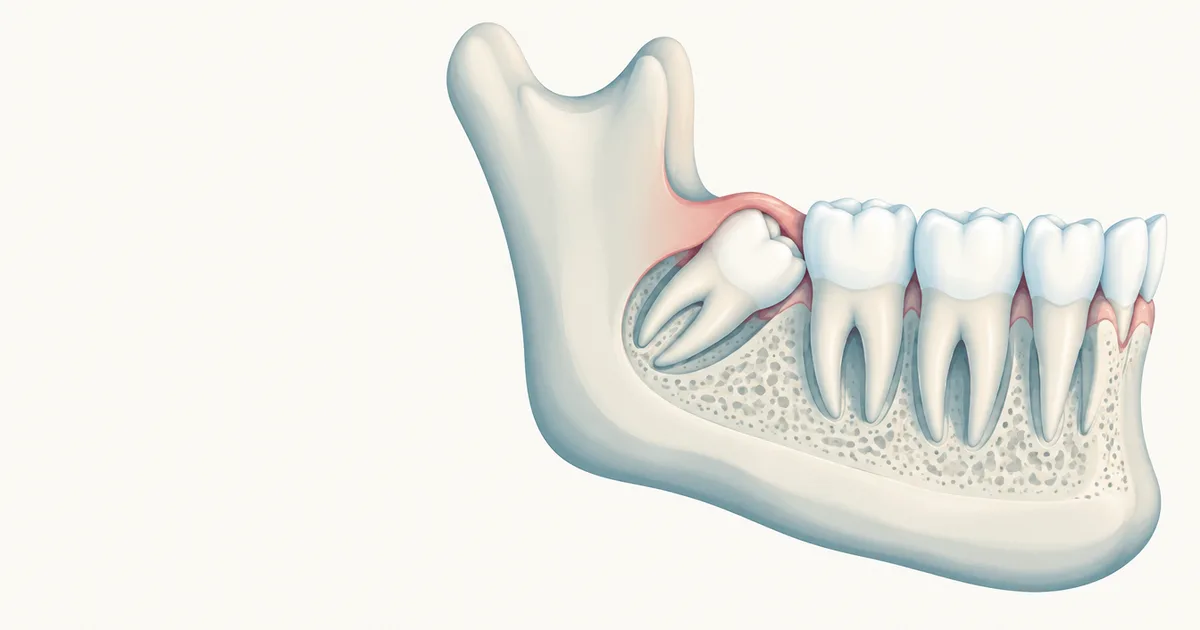
An impacted wisdom tooth is one that does not have room to come through into the mouth normally. The jaw runs out of space behind the second molar, so the tooth stops part-way — buried in bone, trapped under gum, or tilted into the tooth in front of it.
Dentists describe them by the direction they point. A mesial impaction angles forward into the neighbouring molar and is the most common. A vertical impaction is upright but stuck. A horizontal impaction lies on its side and is the most awkward to remove. A distal impaction angles backwards. Separately, a soft-tissue impaction means the tooth is through the bone but still under a flap of gum, while a bony impaction means it is still held in the jawbone itself.
Those words matter to you only because they change how involved the removal is, and therefore how long it takes and how sore you are afterwards. A soft-tissue case can be quick. A horizontal bony impaction is a genuine surgical procedure and should be described to you as one.
No. A wisdom tooth that has come through straight, meets its opposite number when you bite, and can be reached with a toothbrush is a working tooth. There is no reason to remove it. Plenty of people keep all four for life.
Removal is recommended when the tooth is causing a problem, or when it is clearly going to. The usual reasons are repeated infection of the gum flap over a partly erupted tooth, decay in the wisdom tooth or in the second molar it presses against, a cyst forming around a buried tooth, pain that keeps returning, or damage to the root of the tooth in front.
The grey area is the impacted tooth causing no symptoms at all. A fully buried wisdom tooth that has never hurt, in someone in their forties, is often best left alone and watched. The same tooth at nineteen, angled hard into the second molar, is a different calculation — removal is easier and healing faster at that age, and the second molar is worth protecting. That is a judgement rather than a rule, and it should be explained to you, not announced.
Worth booking if you notice any of these, rather than waiting for them to become constant: pain or pressure at the very back of the jaw, particularly if it arrives in waves over weeks; gum at the back that is swollen, red or sore to touch; a bad taste or smell that will not brush away; difficulty opening your mouth fully; swelling along or under the jawline; ache in the ear or the side of the head on one side only; or food packing stubbornly between the last two teeth.
That swollen, sore gum flap has a name — pericoronitis — and it happens when food and bacteria get trapped under the gum covering a partly erupted tooth. It tends to settle, then come back.
Swelling that is spreading, a fever, or any difficulty swallowing or breathing is not a wait-and-see situation. That needs to be seen the same day.
A straightforward extraction loosens a tooth that is already fully in the mouth and lifts it out whole. An impacted wisdom tooth usually cannot be reached that way, because part or all of it sits under gum or bone and it may be locked against the tooth in front.
So the procedure is different. The gum is opened to expose the tooth, a small amount of bone over it may be removed, and the tooth is often sectioned — divided into two or three pieces — so each piece can come out through the space available without forcing the neighbouring molar. The site is cleaned and the gum stitched back. It is surgery rather than a pull, which is why it is planned rather than done on the spot.
Kosmoss Dental carries out surgical removal of impacted wisdom teeth at the clinic in Niti Khand I. For a routine impacted wisdom tooth you are not sent elsewhere.
This cannot be planned by looking in the mouth. What matters is invisible: the shape of the roots, how deep the tooth sits, which way it is angled, and how close it lies to the nerve running through the lower jaw — the inferior alveolar nerve, which supplies feeling to the lip and chin.
For many cases an X-ray taken in the chair is enough. Where a fuller view of the whole jaw is needed, we send you to a nearby diagnostic centre for an OPG or a CT and read the result with you here. Kosmoss Dental does not run that imaging on site, and we would rather tell you that than imply otherwise. In practice it adds a day, not a week.
That image is what decides whether a case is simple, whether the tooth needs sectioning, and whether the nerve sits close enough to change the approach or the conversation about risk. If anyone offers to remove an impacted lower wisdom tooth without looking at an image of it first, ask why.
You will be awake. The area is numbed with local anaesthetic, and numbness rather than pain is what to expect. Pressure and movement you will feel; sharpness you should not, and if you do, you say so and more anaesthetic goes in. There is no prize for enduring it quietly.
A simple soft-tissue case can be over in fifteen or twenty minutes. A deeply buried horizontal impaction can take closer to an hour. Most sit between the two. Stitches are usually placed and are often the dissolving kind, so there may be nothing to come back for.
Arrange to be driven home, or at least not to be in a hurry, if it is a lower impacted tooth — not because you will be impaired, but because you will be numb, a little swollen, and not in the mood for a scooter.
The first twenty-four hours matter most: leave the clot alone, do not rinse hard, do not spit, do not use a straw, do not smoke. Swelling usually peaks around day two or three and then eases. Soft food, a cold compress on the outside of the cheek, and the pain relief you are prescribed cover most of it. A surgical removal is sorer than a simple one, so two to three quieter days is realistic rather than one.
The full aftercare — what to eat, what dry socket actually feels like, how to tell healing is going well — is covered properly in our guide to tooth extraction recovery in Indirapuram. No point repeating it here.
Sometimes nothing, for years. That is a real outcome and it deserves saying plainly, because the alternative advice — take them all out just in case — is not good advice either.
But the risks of leaving a tooth that is already causing trouble are specific rather than vague. Pericoronitis tends to recur, and each episode is more miserable than the last. Decay forms where the wisdom tooth presses against the back of the second molar, a spot you cannot brush and usually cannot see — which is how people lose a healthy second molar to a wisdom tooth they were ignoring. A cyst can develop around a buried crown and enlarge quietly. And removal gets harder with age as bone becomes denser and roots more fully formed.
The question is never “should wisdom teeth come out.” It is whether this tooth, in this mouth, is doing harm or heading that way.
No — and the reverse is not true either. The idea that erupting wisdom teeth shove the front teeth crooked is a persistent myth; front teeth crowd with age in people who never had wisdom teeth at all. Removing them will not straighten a crowded smile. If crowding is the thing that bothers you, that is an alignment question, not an extraction one.
How many can be taken out at once?
Commonly one side at a time, upper and lower together, so you can chew on the other side while you heal. All four in a single sitting is possible in some cases but is not the default.
Will I be put to sleep?
For a routine impacted wisdom tooth, no. Local anaesthetic is standard and sufficient. Cases that genuinely need general anaesthesia are uncommon, and where one is indicated it is arranged properly with a specialist rather than improvised.
Is it worse for the lower ones?
Usually yes. Lower wisdom teeth sit in denser bone, are more often impacted, and lie closer to the nerve. Upper ones frequently come out more easily than people expect.
How long before I can go back to work?
Most people with a desk job take the day itself and the following day. Physical work, the gym and travel are better left for two to three days after a surgical removal.
Can it be removed while it is infected?
An acute infection is usually settled first with antibiotics and cleaning, and the tooth removed once the area is calm. Operating into an actively infected site is avoided where it can be.
What does it cost?
It depends entirely on how the tooth is positioned, which is exactly what the X-ray establishes — a soft-tissue case and a horizontal bony impaction are different procedures. A consultation at Kosmoss Dental is a flat ₹500 and includes an examination and, where needed, an X-ray. You are given the figure for your own case before anything is booked.
Dr Varnica Sharrma has practised in Indirapuram since 2015 and holds a BDS with certification in endodontics and implantology. Surgical removal of impacted wisdom teeth is carried out at the clinic. Where a case genuinely falls outside general practice, Kosmoss Dental engages, on a need basis, with specialists who are excellent in their respective fields, so that you are treated by the right person rather than by whoever you happened to walk in to see.
If there is an ache at the back of your jaw that keeps returning, the useful first step is a small one: a ₹500 consultation, an X-ray if it is needed, and a plain answer about whether this tooth has to come out or can safely be left where it is. Kosmoss Dental is at Niti Khand I, Indirapuram, Ghaziabad — call +91 98999 86789 to book.
Author
No tags available